

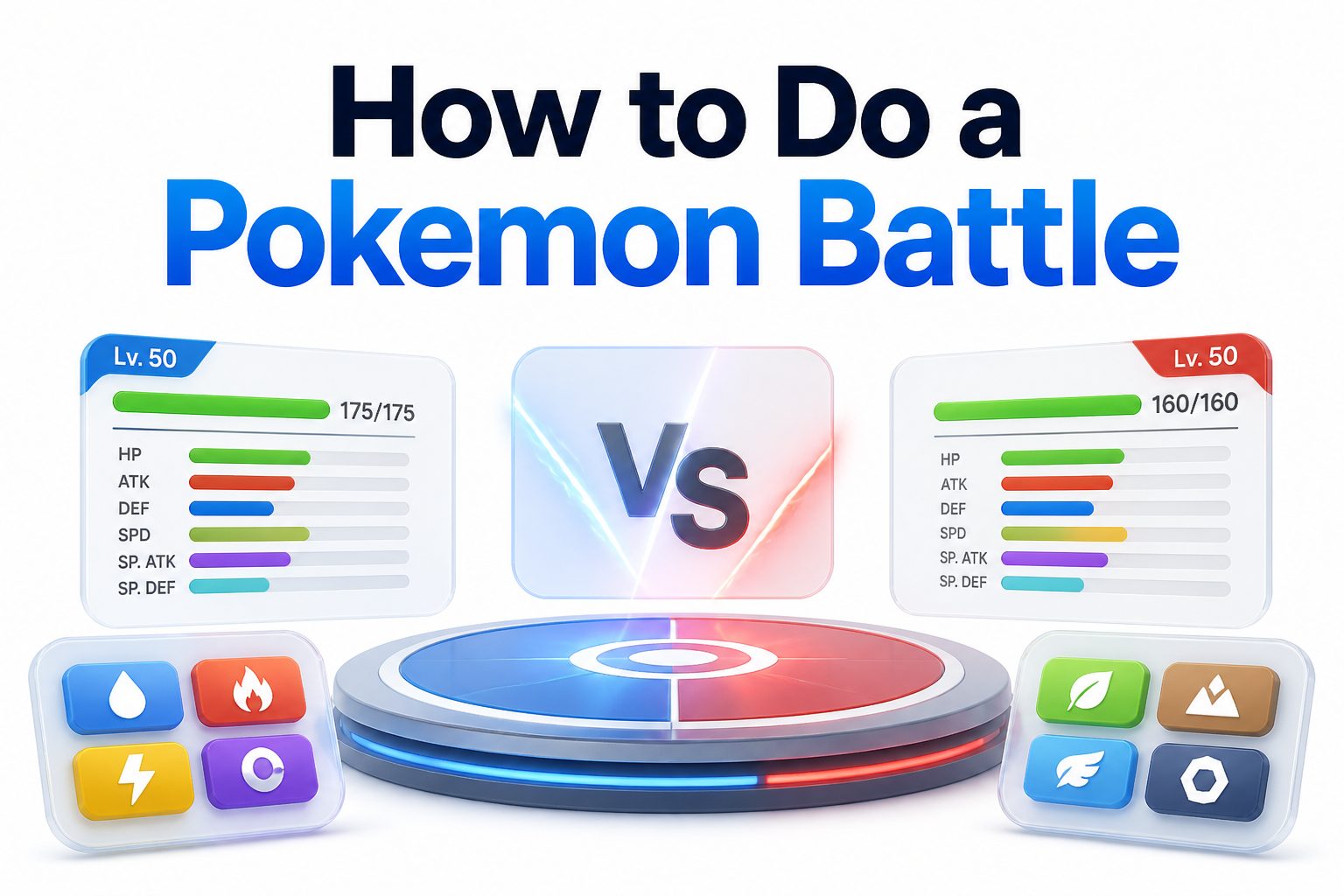
Pokémon battles are one of the most exciting parts of the series because they mix simple rules with real strategy. At first, battles can look easy: choose a move, attack, and hope your Pokémon wins. Once you play more, though, you start to see that every turn matters. Team setup, type matchups, speed, items, and timing all shape the result.
If you want to learn how to do a Pokémon battle the right way, you need more than a basic idea of attack and defense. You need to know how battles begin, how turns are decided, and what makes one move better than another in a given moment. This article breaks the process into clear steps so you can battle with more confidence, avoid common mistakes, and make smarter decisions whether you are playing the main story, battling friends, or testing yourself online.
What a Pokémon Battle Actually Involves
A Pokémon battle is a turn-based match where each trainer sends out a Pokémon and chooses actions each round. Most battles are won by knocking out every opposing Pokémon, but the path to that result depends on planning, prediction, and knowing how your team works together.
Learning how to do a Pokémon battle starts with recognizing that damage alone does not decide everything. Speed order, status effects, switching, held items, and move accuracy can change the flow quickly. Strong players do not just hit hard. They manage risk, control momentum, and react to the board state.
Battle Formats You Should Know First
Not every Pokémon battle follows the same format, so it helps to know the basic types before you begin. Single Battles use one active Pokémon per side, while Double Battles use two. Some games also include Multi Battles, rotation rules, or special challenge formats.
Format matters because it changes what counts as a good move or team choice. A move that feels average in singles may become excellent in doubles because it hits multiple targets or supports a partner. If you want better results, match your strategy to the format you are playing.
Quick Essentials Before Your First Battle
- Know your Pokémon’s type and its weaknesses
- Check whether your moves are physical, special, or status
- Pay attention to move accuracy and power
- Carry useful held items when the format allows them
- Learn the difference between attacking and switching
- Keep a balanced team instead of stacking one type
How Turn Order Works in Battle
Most turns begin when both trainers choose an action, then the game decides what happens first. In many cases, the faster Pokémon moves before the slower one. However, move priority can override speed, which is why some attacks go first even from slower Pokémon.
This is one of the biggest points new players miss when learning how to do a Pokémon battle. A fast Pokémon can finish a weak target before taking damage, while a priority move can save a slower one from being knocked out. Turn order is not a detail. It often decides the whole exchange.
Moves, Damage, and Battle Roles
Each move serves a purpose, and not all strong teams rely on raw power. Some moves deal direct damage, some raise stats, some lower the opponent’s stats, and others inflict status conditions. A smart battle plan uses a mix of pressure, disruption, and setup.
Pokémon also fill roles. One may be a fast attacker, another a bulky wall, and another a support option with status or healing. When you understand roles, you stop choosing moves randomly and start building turns that support a larger plan. That is how battles become more consistent.
Simple Battle Checklist
- Confirm your active Pokémon has a favorable matchup
- Look at your remaining HP before choosing a risky attack
- Check if a switch is safer than staying in
- Use status moves when they create long-term value
- Save your strongest option for the right target
- Avoid wasting turns on low-value attacks
Why Type Matchups Matter So Much
Type matchups are at the center of every Pokémon battle. Fire beats Grass, Water beats Fire, and Electric pressures Water, but the chart becomes more layered once dual types enter the picture. One Pokémon may resist one attack type while being extremely weak to another.
If you ignore type effectiveness, you will lose many battles that were otherwise winnable. A weaker Pokémon with the right typing can beat a stronger opponent through smart move choice alone. For that reason, many players keep a type chart nearby or review one before serious matches.
How STAB Changes Your Move Choices
STAB stands for Same Type Attack Bonus. When a Pokémon uses a move that matches one of its own types, that move gets a damage boost. This matters because a move with slightly lower listed power may still hit harder than a non-matching option.
When deciding how to do a Pokémon battle efficiently, STAB should influence your move selection. A Water-type Pokémon using a Water move often gets better value than using a neutral off-type move. Pair that with type advantage, and damage can rise sharply in a single turn.
Type Matchup Reference
Type Situation | Result in Battle | Practical Impact
Super effective hit | Deals extra damage | Good for fast knockouts
Not very effective hit | Deals reduced damage | Often wastes a turn
Immune target | Deals no damage | Forces a switch or new plan
STAB plus advantage | High damage output | Strong offensive pressure
Resistance plus bulk | Reduced incoming damage | Good defensive pivot
Building a Team That Can Actually Win
A solid team is not just six Pokémon you like. It needs coverage, role balance, and answers to common threats. That usually means combining offense and defense instead of filling every slot with slow tanks or fragile attackers. A balanced roster gives you options when the match shifts.
You also want type variety, but variety alone is not enough. Your team should have a clear plan. Maybe it wears opponents down with hazards and status. Maybe it focuses on speed and offensive pressure. Maybe it uses defensive pivots to create safe entries. Good teams make each member useful.
Choosing Pokémon Roles With Purpose
When assigning roles, think about what each Pokémon is supposed to do when it enters battle. A lead may set hazards or pressure early. A wall absorbs damage. A revenge attacker finishes weakened targets. A support Pokémon spreads paralysis, heals teammates, or blocks setup.
This structure helps you avoid overlap. If three Pokémon do the same job, your team becomes predictable and weak to certain matchups. Players who know how to do a Pokémon battle well usually build with intention, not just preference. Every slot should solve a real problem.
Strong Team Building Habits
- Include answers to common types like Water, Ground, and Dragon
- Carry at least one reliable switch-in for physical pressure
- Use speed control through fast Pokémon or priority moves
- Avoid stacking the same weaknesses across multiple team members
- Make sure your team can damage bulky opponents
- Test your team and adjust after real battles
Items, Abilities, and Status Conditions
Held items can make a major difference in battle even when the moves stay the same. Recovery items help bulky Pokémon survive longer, power-boosting items raise damage output, and choice-based items can create immediate pressure. The best item depends on the role your Pokémon is meant to play.
Abilities matter just as much. Some reduce damage, some change weather, some block status, and others increase speed or power under specific conditions. You do not need to memorize every ability at once, but you should know the abilities on your own team and the most common ones you face.
Using Status to Control the Match
Status conditions are often more valuable than beginners expect. Burn reduces physical damage in many cases, paralysis can slow key threats, poison creates steady chip damage, and sleep can remove a target from action for several turns. These effects force the opponent to adjust.
Status works best when used with purpose. Do not click a status move just because it is available. Use it when it punishes a switch, weakens a dangerous attacker, or helps your team outlast the opponent. Smart status play often wins slower battles without needing flashy damage turns.
Important Status Effects at a Glance
Status | Main Effect | Best Use
Burn | Reduces staying power and often weakens physical attackers | Against physical threats
Paralysis | Can slow or interrupt the target | Against fast sweepers
Poison | Adds steady damage over time | Against bulky teams
Sleep | Temporarily removes actions | To create momentum
Freeze | Rare but powerful if it lands | Situational bonus effect
When to Attack and When to Switch
One of the hardest parts of battling is knowing when not to attack. Staying in for damage can feel productive, but if your active Pokémon is in a terrible matchup, switching may be the stronger play. Good switches preserve resources, create pressure, and stop you from losing a key team member too early.
A switch is especially useful when you expect a super effective hit, a setup move, or a status attack your next Pokémon can handle better. Learning how to do a Pokémon battle well means accepting that every turn is about value, not pride. You are trying to improve your position, not force every exchange.
Reading the Opponent Without Guessing Wildly
Prediction matters, but it should be grounded in logic. Ask what the opponent gains from each likely move. If they have a strong type advantage, they may attack. If your current Pokémon threatens theirs, they may switch. Strong reads come from patterns, not random instincts.
Do not overpredict early in your development. Many players lose games by trying to appear clever instead of making the solid play. Take the safe line when it keeps your position stable. As you gain experience, you will recognize when a bold move is justified and when it is simply risky.
Practical Battle Tips
- Switch out if your Pokémon cannot survive or threaten back
- Attack directly when the reward clearly outweighs the risk
- Keep your fastest attacker healthy for late-game cleanup
- Watch for repeated patterns in your opponent’s choices
- Avoid sacrificing a useful Pokémon without a clear payoff
- Use [Internal Link: Pokemon type chart guide] when reviewing matchups
How to Win More Single Battles
Single Battles reward clean matchup management and careful switching. Since only one Pokémon is active at a time, every entry matters. Hazard damage, status, and prediction all become more noticeable because there is less immediate support on the field to cover mistakes.
If you want to improve in singles, focus on turn efficiency. Do not give up free damage by staying in against a bad matchup. Use pivots and bulky Pokémon to create safer turns for your offensive threats. Singles often favor the player who wastes fewer actions over the full match.
How to Handle Double Battles Better
Double Battles are faster and more tactical because four Pokémon are active at once. Positioning matters more, and support moves become much stronger. Protect, speed control, spread attacks, redirection, and partner synergy all play a bigger role than they do in most singles formats.
When learning how to do a Pokémon battle in doubles, start by thinking in pairs instead of individuals. One Pokémon may set up the field while the other attacks. One may redirect danger while the partner boosts. Good doubles play comes from coordinated turns, not isolated move choices.
Single vs Double Battle Comparison
Feature | Single Battles | Double Battles
Active Pokémon | One per side | Two per side
Main focus | Matchups and switching | Positioning and synergy
Useful tools | Hazards, pivots, walls | Protect, spread moves, support
Pacing | Usually steadier | Usually faster
Beginner challenge | Reading switches | Tracking multiple threats
Common Beginner Mistakes to Avoid
Many new players lose because they treat every battle like a simple damage race. They use their strongest move every turn, ignore type weaknesses, and keep weakened Pokémon in play too long. That approach may work against easy story fights, but it breaks down against smarter opponents.
Another common issue is poor team planning. Players bring overlapping weaknesses, skip status support, or rely too much on one star Pokémon. If that one Pokémon gets countered, the whole team collapses. A better approach is to spread responsibility across the roster and prepare for different situations.
How to Practice Without Feeling Overwhelmed
The best way to improve is to focus on one battle skill at a time. Spend a few matches paying close attention to type matchups. Then spend a few more tracking turn order and priority. After that, work on switching decisions. Small improvements stack up quickly.
Practice also becomes easier when you review your losses honestly. Ask why a battle turned against you. Did you ignore a weakness, lose speed control, or waste a useful Pokémon too early. If you track those patterns, your decision-making becomes sharper much faster than endless casual play.
Helpful Practice Checklist
- Learn your team’s roles before entering battle
- Review one or two losses after each session
- Keep notes on repeated matchup problems
- Test different held items on the same Pokémon
- Use [Internal Link: best beginner Pokemon team tips] for team ideas
- Practice against friends or low-pressure online formats
Conclusion
Pokémon battles are most rewarding when you move past button pressing and start thinking like a trainer with a plan. The core rules are easy to learn, but the depth comes from type matchups, turn order, switching, team roles, abilities, and timing. Once those pieces start to connect, battles feel far less random and much more skill-based.
The good news is that improvement does not require elite knowledge or perfect prediction. It comes from consistent habits: choosing balanced teams, using status and items wisely, respecting matchups, and protecting your win conditions. If you keep practicing with those ideas in mind, you will make better choices under pressure and enjoy battles more. Whether you play through the main games, challenge friends, or step into competitive formats, knowing how to do a Pokémon battle gives you a stronger foundation every time you send a Pokémon onto the field.
FAQ
What is the first thing to learn in a Pokémon battle?
Start with type matchups and turn order. If you know which attacks hit hard, which ones are resisted, and which Pokémon will usually move first, you will make much better decisions from the opening turn.
How many Pokémon should a beginner train for battle?
A beginner should usually focus on building a balanced team of six for standard play. That gives enough variety to cover weaknesses while still being manageable when learning roles, items, and basic battle strategy.
Are status moves worth using in battle?
Yes, status moves are often worth using because they create long-term pressure. Burn, paralysis, poison, and sleep can limit the opponent’s options, weaken attackers, and make it easier for your main damage dealers to finish battles.
Should I switch Pokémon often during a battle?
You should switch when your current matchup is poor or when another teammate can gain better value. Switching too much can be risky, but refusing to switch at all usually leads to avoidable knockouts and weak positioning.
Can I win without using legendary Pokémon?
Yes, you can absolutely win without legendary Pokémon. Good team structure, smart move choices, type coverage, and sound turn management matter more than rarity in many battles, especially against casual players and evenly built teams.
0 Comments